Pages

Wednesday, July 17, 2019

Going Fishing at School... icebreaker!

I'm knee deep in curriculum development today and ran across a "fun" little "go fish" activity from We Are Teachers. Go check it out there! You can even download a template and create your own. Here's mine:  (PDF)

I'm gonna go pick up some tree limbs (maybe.. or maybe I'll buy some sticks...lol), grab some string, get some magnets and let the kids get in groups and fish for questions. Students struggle making conversations, so my rule will be that you:


  1. Get in groups of 5 (I think that's a good size).
  2. Dump the fish in the sea (I had to decide whether I want to put them in something so it's more random or let them see the colors so they can somewhat pick the fish... decided on the latter so my shy people would feel some element of control over the questions). 
  3. Take turns fishing. After you fish, you read the question out loud and answer it. Then, at least two people in the group (you could make rules about who... like the person to the left and the right of you, for example) have to ask a follow-up question and you have to respond. 
Looking forward to seeing how this goes over and hoping no one gets "seasick."  :) he he

Tuesday, July 2, 2019

Why I Work All Summer....

So many people "get on me" about going to school in the summer. First, let me be clear. I don't get up at the crack of dawn to get to work in the summer. I sleep in, roll in to work around 9:30 or 10 AM and stay only a few hours and not every day. But, the building is generally empty with few teachers around when I am here during the summer break.

So, why?

First, I am a technology teacher and keeping up with technology is not something I can "do well" by just managing during the school year. Sure, I can try to catch a random YouTube video or follow the Adobe Twitter feed during the school year and learn about a new feature, but I cannot dive in and really immerse myself in the software during the school year when I am busy trying to teach my "five prep" schedule. It's just not possible. So, summer it is. I must update myself on my technology skills, learn the new things that are happening in the Adobe and Microsoft worlds, and get comfortable with it so I can teach it when school resumes.

Second, curriculum doesn't update itself.  I'm not dissing my Social Studies and Math friends; I know you also do a ton of prep outside of contract time. But, history and math are pretty static. Business and technology are always changing and it's a disservice to my students to just continue to teach content that's a few years old. I have to update articles to match what's happening now. My projects and curriculum must reflect current industry standards and expectations. And, if I don't do it, no one will... unless I can somehow find some little curriculum elves around here (no luck so far).

Third, backwards design requires me to evaluate and update assessments OUTSIDE of school time. I give a pre-test and post-test in each of my classes. Over summer, I review the data to see what questions were low scoring. Then, I either update the assessment to better reflect what I taught OR I update my lesson on that content to better prepare students. I find it is MY FAULT if they cannot score well on my assessments and I have to be responsible to find the solution. I use Zipgrade to review item analysis and consider low scoring questions... clearly, I need to focus more on the "Principles of Design" unit on Web Design for next year:


Finally, being a teacher is part of who I am. I love to teach. I aim to do it well. Though I often feel my efforts are unnoticed or unappreciated, I don't do it for recognition, better pay, or a pat on the back. Whether my students or administration appreciate it or not, I know if I am making my best effort. Anything worth doing is worth doing well.

So, don't feel sorry for me for working during the summer. It's part of who I am. I am devoted to being the best teacher I can be and I don't apologize for it. But, don't worry. I make time for ME and my kiddos, too. I already watched the entire new season of the Flash and am a few seasons in on Heartland right now, I've seen the new Men in Black, Child's Play, and Toy Story, and I've attended a few conferences. All work and no play makes anyone crazy, right?  :)  I hope your summer is moving along beautifully!

Wednesday, June 12, 2019

It's not the first day yet! But, planning for a good year!

Like most of you, I am on summer break. In between revising curriculum, conducting teacher training, planning for conferences I present at later this summer, and RELAXING, I am still searching for ideas for next school year. I always want to improve from year to year!

I was thinking today about how important starting off on the right foot is for students. My daughter is a good student, but she takes it very personally if she has a bad "teacher encounter" early on in a class. We had one such example her sophomore year (and, truly, that teacher did not treat her properly, so her reasons were valid). A teacher did not like the fact that she wasn't thrilled about his science class and put her on the spot about it (oh, let me mention, she made an A in the class). He damaged that relationship to the point of no return within the first two months of school saying that if she didn't "act like she liked this class more" then he "won't help her in the future."

WOW.

I try very much to avoid judging students. But, I think it's important for students to judge themselves. They know themselves way better than we do. So, in looking for resources, I found this self-evaluation and goal-setting sheet from MathGiraffe.com (go to their site to download!).


I love the idea of asking students to self-evaluate before they even begin your class. How did they feel about last year? What were they proud of? What do they need to improve on? And, what are their goals for MY CLASS?

Do you ask students to set goals? I often put on a student information form something like "target grade" for my class. I typically put: 

  • Straight A (no minus!)
  • A range
  • B range or higher
  • C range
  • I just want to pass!
You'd be surprised what students are not "okay" with just something in the A range. They do not want that A- and are discouraged by it. Others are going into your class just expecting to get a C. They don't even aspire to higher than that. And, others simply want to not fail. Some put what THEY want and others put what MOM AND DAD expect. 

KNOWING THIS INFORMATION IS GOLD.

You can connect with your students to help them reach their goals and, for some of them, help them realize that they can set higher goals. I encourage you in the fall to take a little time out and have your students set a goal for your class. Perhaps that goal is related to effort, communicating, remembering to log in before the bell rings, not being late, checking grades daily, being open to helping others... sometimes they have to start small. But, come back to this goal and call them to task. If a student puts that they want to "become better at answering essay questions" and they leave a question blank on a test or they write one sentence as a response, you should bring them up to the desk and have a conversation about how this effort is not helping them meet the goal. Instead of griping them out for leaving a question blank, writing in an angry face with your -5 points, or just writing "poor effort," having that conversation related to their goals that THEY set, can help show more of a relationship and concern and less of a judgment.

Good luck!

Friday, May 31, 2019

Illustrator and Photoshop Mock-ups! Smart!

I've participated and viewed Logo Design Contests online for years (mostly to get project ideas). Some of the entries are so fancy, with billboard and glass windows with the logos on them. I always wondered how they took the time to do that for these contests. And, I know the concept of mock-ups....

But, friends, I didn't know you could just download tons of free mock-ups that you could place your artwork into!

My kids are going to love this in the fall!

Have you ever had your kids design artwork for can? A box? A bottle? It's "fine" when you look at it on the computer, I guess, but using a mock-up will get them much more excited and bring their ideas to life.

Here are a few sites that you can get them from:

Just watch my short video here and you can see how to use them. I'll be using this in a workshop I'm doing next week on Illustrator!

Here's my example with my family cycling logo, put nicely on a cup (and I show you how in the video!):


Curriculum Work... Tylenol Murders!

Well, school has been out for less than a week and, while also prepping for a workshop I am giving next week, I am already working on curriculum for next year. I am picking up Business Law (yay!) next year and wanted to try to find a few podcast episodes to work in to the class.

I was listening on my way to work yesterday on the How Stuff Works podcast and they had an episode on the Tylenol murders. I had been reading about the biggest recalls of all time for the unit on product liability and that sort of thing and thought this was timely. So, here's the episode I listened to:

https://www.iheart.com/podcast/105-stuff-you-should-know-26940277/episode/the-tylenol-murders-part-ii-45475709/

I think the students will enjoy it. It's pretty long, so might do a few time cues and have them skip some things so it can fit into one class period and leave time for discussion (this is part 2, I didn't listen to part 1).

My thought is to play it and have a visual "notes sheet" they will work on while they listen to help them listen (more of a scavenger hunt to figure out why the words/dates/etc. are important).


I honestly think this would work in a variety of business classes since it really discusses the public
relations needed to come back from a crisis like this one.

Anyone have any other good podcast episodes kids might enjoy?

Wednesday, May 22, 2019

Old School Typing Tournament! #busedu

This week in my Computer Applications class, we've had some fun. Last week, I had students take about half the hour to do some typing practice (Typing Academy 2 minute timings). I walked around while students were typing just checking out their typing speeds (which, by the way, my students were pretty impressive! I had 12 out of my 25 who were typing around 50 wpm or more!). If they got a speed they wanted me to see (improved), they could call me over and I recorded it old school on a clipboard.

I had decided to probably take the top 10 or so and create a bracket, but due to time, I just went with top 8. I found an online "bracket" through Challonge and plugged in the names based on their ranks on my walkarounds and put it on my class website and Twitter, so they could all see who was ranked where. They were quite eager for me to update it each day!


The competition rounds were fierce! They had to type at my teacher computer at the front of the room on the big screen (yep, where everyone could watch). PRESSURE. And it really affected speeds. They were feeling it! I always had the  lower seed go first and they got TWO attempts, just to take a little pressure off. Round 1 we did over two class periods and then the other rounds on two different days. Students were also working on their independent review (Mindtap SAM reviews for our final exam, which got boring sometimes, so this was a distraction at times for those who wanted a break!).

I used this website and created a "custom text" timing (sign up with a Google account for free and you can create and save your own) that they typed (this example is round 3, which I actually gave my top two the night before so they could practice on their own), but I started with different text for the other rounds and they didn't get to practice it in advance)-->
         Final Round  https://www.keyhero.com/custom-typing-test/tournament-3/

To determine their actual "score" I took the words per minute times the accuracy rate. If you look at my bracket, it was pretty close a few times and accuracy mattered!

If I were to do it again, I might do two brackets (silver and gold, tiered so slower ones have a chance to win) or a double elimination. I probably should have done a third place match, too. But, this was my first attempt. In my Computer Apps class, students do Typing Club as a side thing and in class several days during the semester, so we are always encouraging them to improve typing speed and accuracy; this was just a fun way to end the course, and it was a bit fun listening to the students root for the underdogs!


Thursday, April 11, 2019

Seesaw Amazing Race? We Tried!


I attended a PD session at my school (Jackson R-2!) last week on using Seesaw for an "Amazing Race" activity. I know lots of elementary teachers use Seesaw, but I've not known a high school teacher using it (I wasn't really interested in the student work journals and parent sharing) so this intrigued me. Also, I felt dumb... I hadn't used it and they all knew their way around! I also never use iPads, so I was just confused. But, I completed their example activity and decided to give it a whirl.

I set off to create an activity for my Web Design 2 class. They are a great group of kids (and my small class of 11, so great guinea pigs). I decided to do a blended activity that allowed us to leave my computer lab to complete the race with their Chromebooks.


Process

I set up four groups (just colors) and the kids picked their own groups (of 3 or 2). I set those up as my "students" in the class (I didn't want them to be individuals or use their Google accounts to log in). When they do an activity and upload, it asks them what group to add it to, so that's how that worked using the login code.

I created four stops on our race (activities in Seesaw)--

Stop 1:   You'll need paper and markers. In your group, create the HTML tags for an image named dog.jpg that is centered on the page with an appropriate text alternative. Each tag and/or attribute should be on a separate "block" of paper (tear apart as needed). Don't forget to close your tags!  Take a photo and post it here!  (I set it up in the hallway with strips of paper and a box of markers).


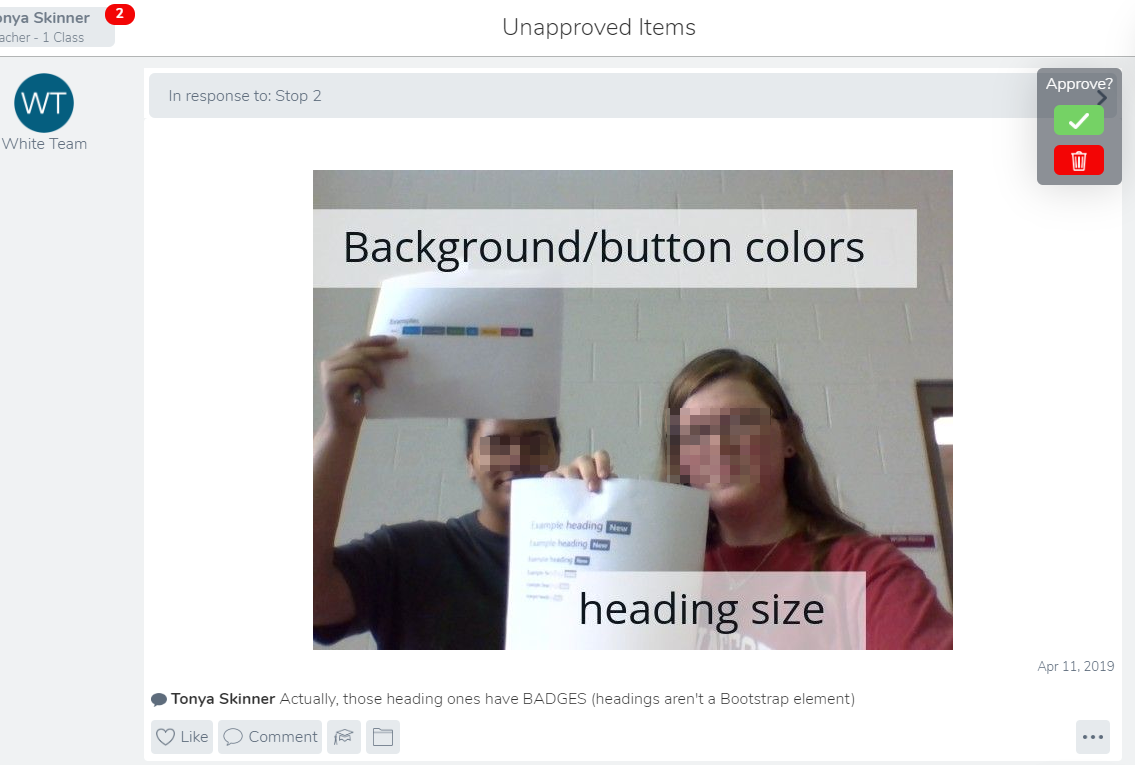
Stop 2:  Find the Bootstrap wall. Take a picture with two group members holding two of the examples. Then, add text to identify what bootstrap feature or component they illustrate before posting.  (I printout out screenshots of bootstrap components and tacked them up on the railing in the hallway near my room)


Stop 3:  In your own words, your group members should use the following terms in a SPOKEN paragraph (either video or audio). Be sure your use of the term clearly shows you know what it means! I am not looking for dictionary definitions, but rather "real people" explanations.

Not worth credit--(isn't descriptive)
"John really liked the webpage that had the jumbotron and favicon because they made the page look cool."

Select at least 5 terms from this list----
Jumbotron, hexadecimal, favicon, thumbnail, CSS, class, HSLA, Javascript, hyperlink

Stop 4:  Listen to your instructor's message to know what to do! (I had an audio message in the app telling them to find something in the lobby by the office, take a picture, and translate the color to a hex code using the app).

Reflection

The students enjoyed the activity. I asked them for feedback about the length of the activity and the setup. They all agreed four activities was good for a high school class and 45 minutes.

The example session I attended didn't really give you all of the "stops" at once and I did with this group because I thought it would keep them all going in different directions and they wouldn't have to wait on me to review their activity before they could move on to the next one. However, the big issue with that was that they didn't know immediately if they were wrong. There isn't a way to "reject" an upload that they submit (just to delete it). I can approve it with a comment saying there's an issue but then they might assume it was okay. So, in the future, I think I will just tell them they have to review their items and my feedback and I will leave a comment on EVERY submission saying approved or denied (with notes for correction).  That might be a little confusing on the end because some may have more submissions than others.... but at least they would have feedback. As it was, when they finished all four, they found me and then I just told them that Stop 2 was denied. It worked okay, but I just need to think through that hurdle.  I think I will have a "final activity" that doesn't have instructions in Seesaw so students can complete the first 3 or 4 in any order and then can only get the final envelope from me IF they have all the others completed correctly. (But, let me tell you, if your tasks are complicated and take awhile to approve, you will drive yourself crazy!).


Another note a student gave was the the video upload took some time and so they had to wait on that to move on. Had I put the "stops" on paper in envelopes rather than in the app, they could have perhaps moved on to the next one. I didn't specific a length on the video, so those took awhile for me to approve (one was 6 minutes long!). So, lesson learned on that.

Overall, I enjoyed this and they did, too. It didn't take a ton of planning. I just need to learn Seesaw better. Our network had moments where I couldn't see their work and such (oh, technology!) but other than that, it was pretty cool!

I'd like to try this with a big class next. My Photoshop class does some photography and I think this would be a fun project to do with that unit while we go roam around taking pics. I also think I can have a "group worksheet" or word play type activity (maybe a scramble with a secret word) that they take a picture of when complete that goes over terminology or something that will keep them thinking as well. But, this is a very interesting way to review content and get kids up and moving!